
With multiple MCP protocols in the design and implementation phases, we think it is timely to discuss how location choice interacts with protocol design to achieve efficient, fair, and censorship-resistant functioning in these systems. In our latest paper, The Price of Decentralization in Block Building, we tackle this problem and answer the question: will the location choices of multiple self-interested proposers improve access for geographically distributed users and transaction sources?
Motivation#
Blockchains are operated by a permissionless set of agents that periodically try to agree on the world state. Protocol design acts as a coordination mechanism, aiming to reach a socially optimal outcome in terms of welfare under the correct functioning of the network. Much of the existing literature studies the incentives for agents to deviate from expected behavior to maximize individual rewards (e.g., selfish mining, undercutting). However, agents can still behave strategically while following the protocol rules, and the welfare implications of the resulting equilibrium state may not be trivial to analyze.
Location choice is one of those areas where self-interested choices can conflict with the socially optimal outcome, and merely following protocol rules may not guarantee symmetric returns for agents operating across the world. For instance, if all Ethereum validators and order-flow providers (i.e., transaction sources) are located in Europe and North America, running a validator from South Africa could be an economically bad decision because of the latency costs incurred: (i) latency for transactions to reach you, and (ii) latency for your block/vote to reach the majority of validators. In such a world, theory would predict an equilibrium location outcome in which all honest and economically rational validators co-locate with each other and with order-flow sources.
Thankfully, reality is a little more distributed, both in terms of validator placement and order-flow origins. Hence, there isn’t a total collapse of geography yet. Still, a large share of validators today operate in Europe and North America, and in a recent paper, Geographical Centralization Resilience in Ethereum's Block-Building Paradigms , we show how the current block-building architecture of Ethereum (under local block building and PBS-like outsourced block building) incentivizes minimizing latency to payoff-relevant entities and eventually leads to a geographically concentrated system.
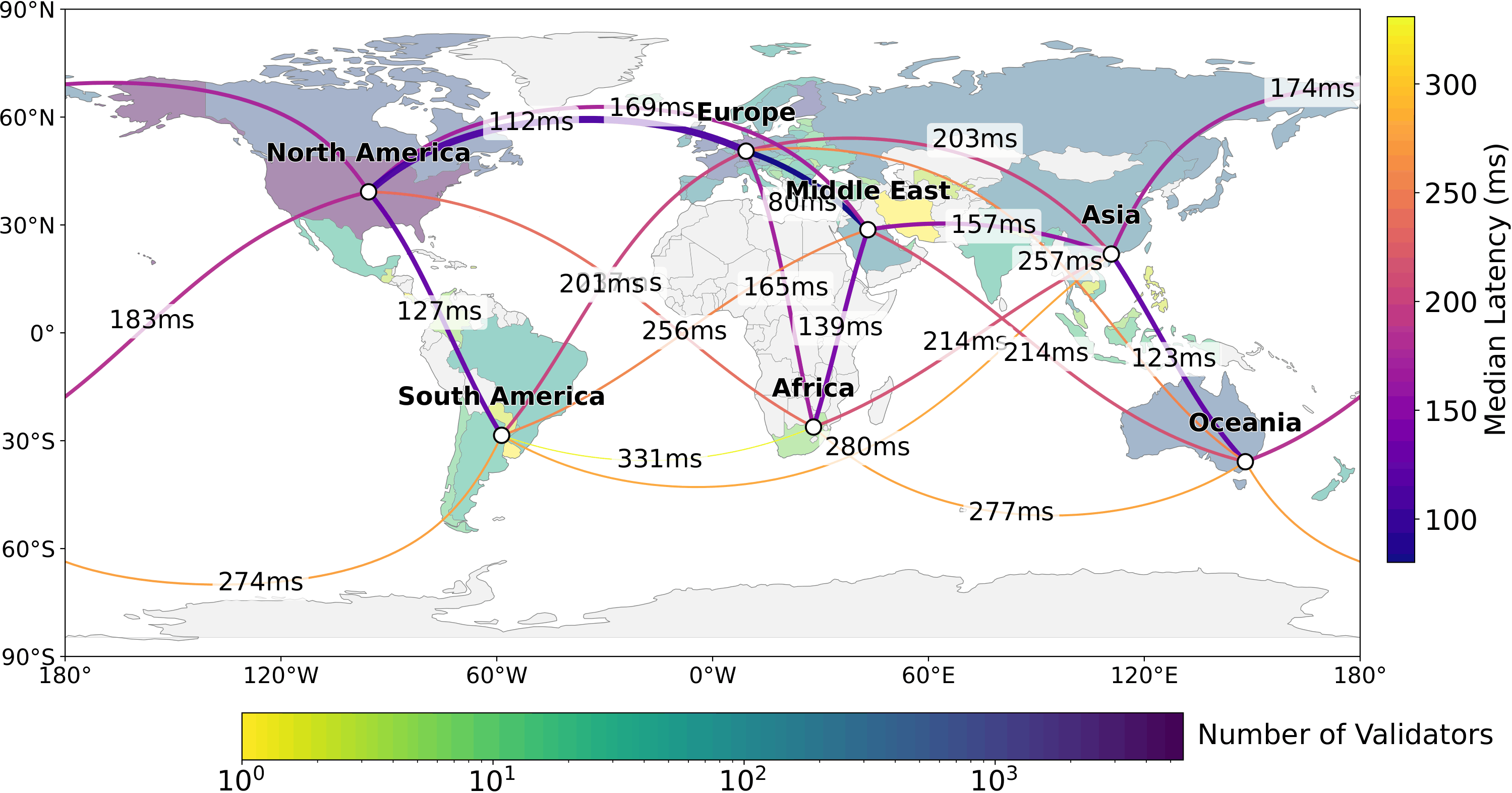
The implications of geographical centralization—which are discussed at length by Phil Daian here—include correlated failures (e.g., due to natural disasters or outages) and asymmetric access to rewards. One can argue that these threats are amplified when the underlying blockchain protocol operates with a single proposer who has a temporary monopoly over block creation. In such networks, geographical concentration may have a direct impact on the liveness of the system (e.g., if the next proposer is unreachable on the network), as well as on censorship resistance, where the proposer may deliberately choose to leave out your transactions or may have to follow governmental regulations preventing the inclusion of certain transactions, as happened with OFAC sanctions on privacy-mixer transactions.
The introduction of multiple concurrent proposer (MCP) systems promotes a remedy to this, where a block’s contents can be provided by multiple entities in the same round. In an ideal world, this would provide a significant improvement over the single-proposer bottleneck on censorship resistance. The idea is simple: if there are proposers in any given round, even if are censoring you, it is sufficient to have one non-censoring proposer who would include your transaction, assuming you pay an adequate fee. Yet, there is a catch: if proposers are geographically concentrated in a region far away from you, latency effects may undo the benefits, reducing your chance of timely inclusion. Although this may not be a big issue for simple payments, for time-sensitive transactions (e.g., in MEV competition settings), you may be left out of because your transaction did not reach at least one of the proposers on time.
One can imagine that this short-term inclusion probability would decrease under the fast block times of the recent MCP protocols, such as Constellation on Solana, Cadence on Monad, and AMP on Arc, as the relative proportion of time needed for your transaction to travel to the closest proposer (relative to the total time the closest proposer can wait to collect transactions) would grow. To express it formally, let be the random variable of your latency to the closest proposer, with a CDF , and let be how long the closest proposer can wait before sending their block to other validators (assume approximates the block time of the consensus protocol). Given two settings with block times , where , if you send a transaction at time under both settings, the probabilities of reaching the closest proposer would be and , with . This means the transaction would reach the closest proposer with a higher probability under the longer block-time setting.
However, block time is only one of the levers of this complex mechanism design problem, with many other decisions to make, such as: how many concurrent proposers are needed; how the rewards should be shared; which rule should be followed when merging the transactions across individual proposers’ blocks; and so on. This raises a critical design question for multi-proposer protocols that decentralize the block-building process to improve the censorship resistance of the network: will the location choices of multiple self-interested proposers, who choose regions to maximize individual utility, actually improve access for geographically distributed users and transaction sources?
Price of Decentralization#
In our recent paper, The Price of Decentralization in Block Building, we tackle this problem. We model decentralized block building as a stochastic coverage game where builders (i.e., proposers) choose geographic regions, while information sources emit transactions over the course of a block-construction round. A builder's region determines the probability that a transaction emitted by a given source reaches the builder before the block deadline. Since multiple builders may receive and include the same transaction, decentralized placement can create redundant coverage: several builders may cover the same high-value sources, while other sources remain weakly covered, diminishing the benefits of the multi-proposer protocol for censorship resistance. As such, coverage choices have welfare implications, and we ask how inefficient and concentrated the resulting placements can be under this decentralized builder region game.
We measure the efficiency loss through the classic Price of Anarchy (PoA) framework, which we interpret in this setting as the price of decentralization, referring to the welfare cost of decentralized self-interested location choices relative to a centrally coordinated placement. The key observation is that when a transaction is already covered by several builders, an additional builder receives only a reduced share of its value under the equal-split reward-sharing rule, while not making an additional contribution to welfare. This allows us to relate unilateral deviations to aggregate welfare. Through this, we show that the stochastic coverage structure of the game preserves the utility game conditions needed for the standard factor-2 PoA bound. We also study utility concentration among builders at equilibrium and establish that the lowest-utility builder earns at least half of the highest-utility builder’s payoff, and that the resulting utility-share Herfindahl–Hirschman index (HHI) is at most 12.5% above the egalitarian benchmark.
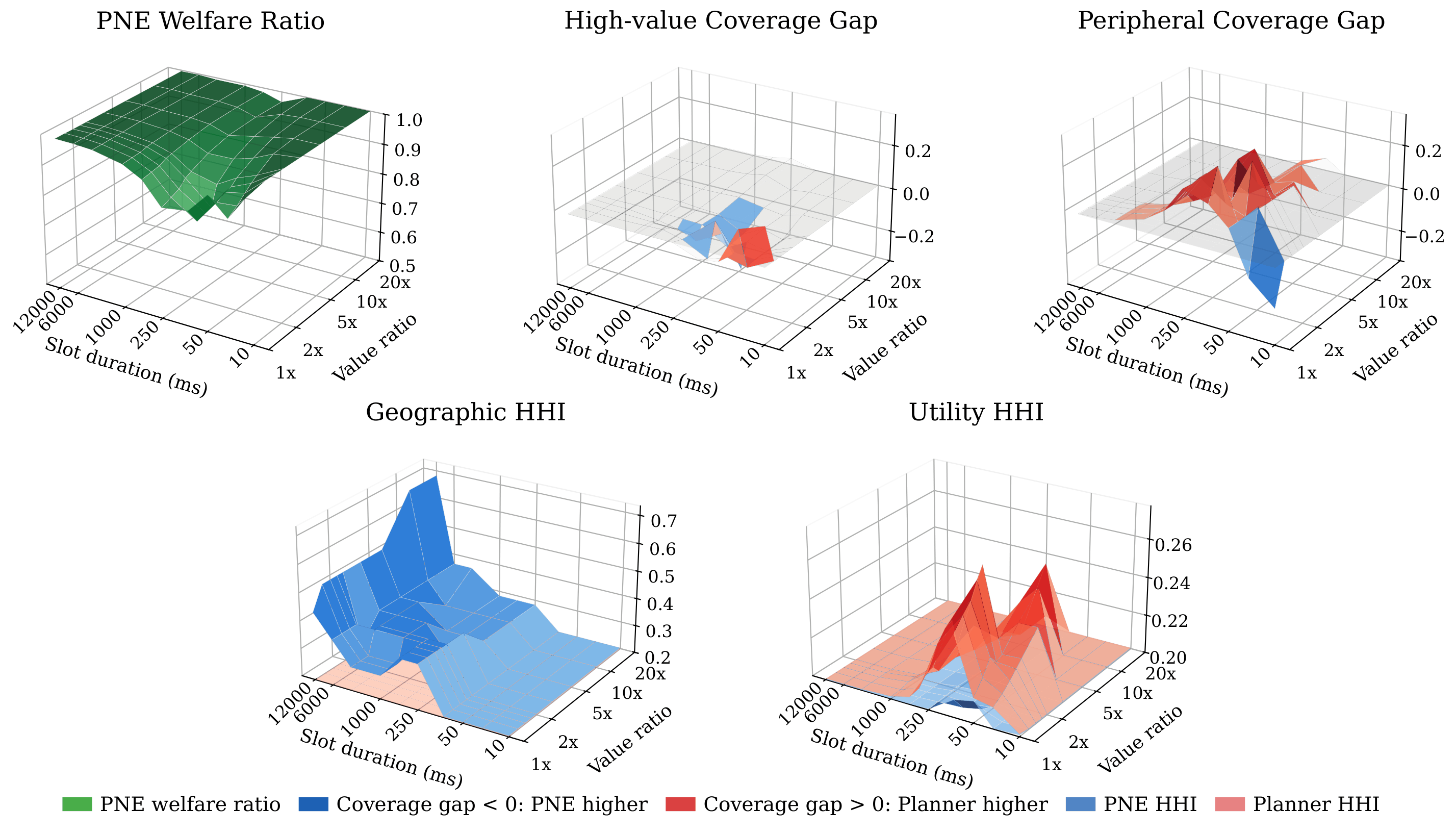
Yet, our theoretical worst-case bounds are not, by themselves, informative on when welfare losses arise in concrete instances. Specifically, we cannot answer how welfare, transaction coverage, and concentration vary with source value, latency, and builder-participation configurations. To address this, we develop a simulator and compare self-interested equilibrium outcomes with centralized planner benchmarks across a set of controlled simulation environments. Settings we study include: various source-value distributions over the network (e.g., every region having the same expected value vs. regions having asymmetric value distributions); changing slot times, which control how strongly Internet latency affects whether transactions arrive before the deadline; and differing builder participations, to test whether additional builders expand coverage or mainly duplicate coverage around attractive sources.
Our findings highlight that efficiency loss is maximized under settings where the majority of value is concentrated, but there are still peripheral regions that are reachable on time with respect to slot times and provide meaningful value. In the optimal outcome, the social planner positions some builders to cover such peripheral regions, but decentralized equilibrium incentives still favor regions with strong access to high-value sources. Hence, the interaction of source-value asymmetry and latency sensitivity drives inefficiency. From a protocol-design perspective, the relevant timing parameter is therefore not slot duration in isolation, but slot duration relative to transaction propagation latencies over the Internet infrastructure.
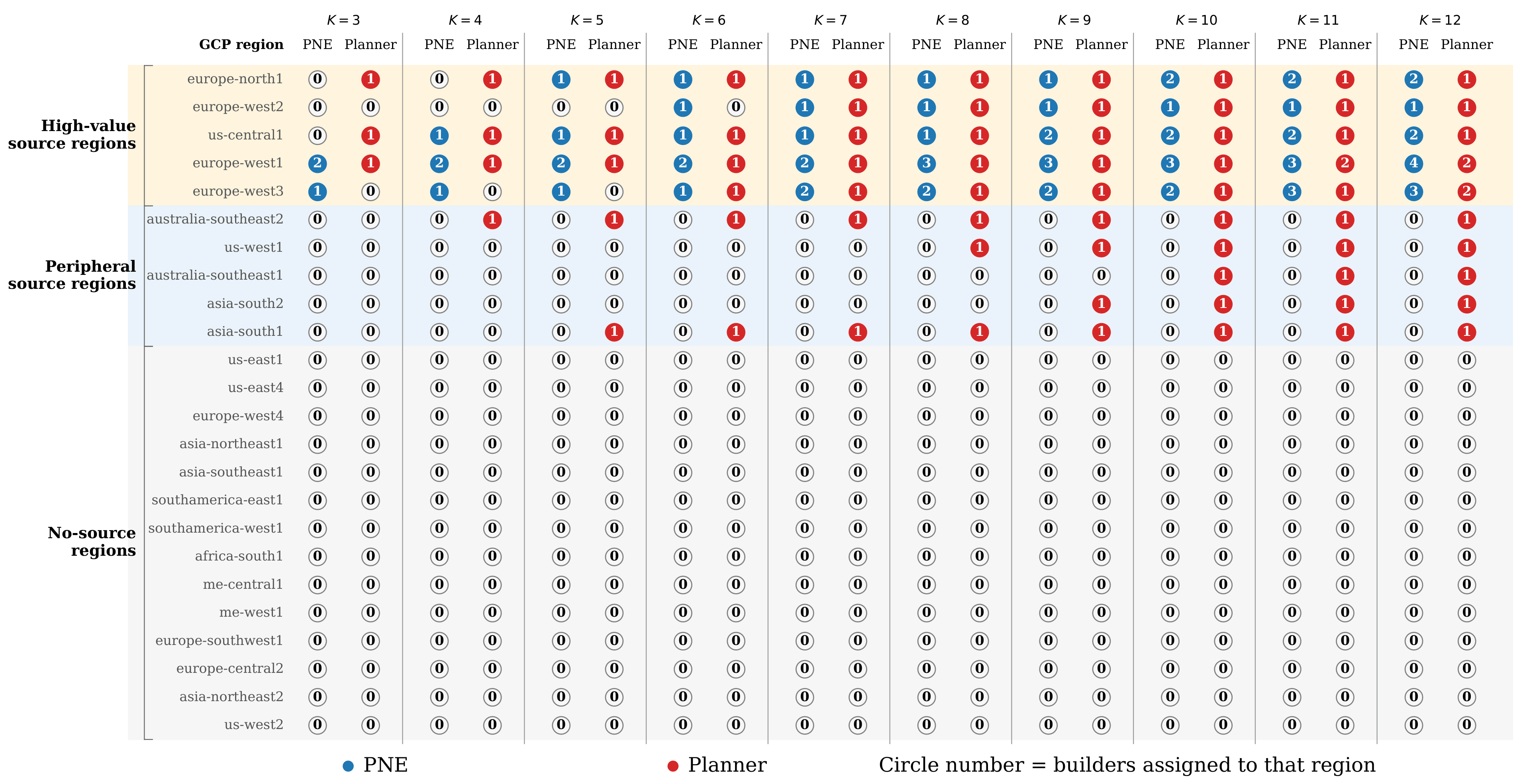
Additional experiments show that increasing builder participation expands potential coverage capacity, but in the finite regime our simulations examine (up to 12 builders), additional builders may not cover peripheral sources immediately. While the planner assigns additional builders to peripheral source regions once high-value coverage is largely saturated, in equilibrium, extra builders selfishly duplicate coverage around high-value sources rather than spreading out to peripheral regions.
Across different settings, one repeating pattern we observe is that geographic concentration and utility concentration can capture different objectives. Planner allocations may often be geographically more dispersed but utility-wise more unequal, because the planner places builders in lower-payoff peripheral regions to improve total coverage, and accordingly, welfare. Equilibrium profiles may instead be more geographically concentrated while keeping builder utilities relatively balanced under equal sharing.
Final Remarks and Future Research#
With this paper, we scratch the surface of the interaction between multi-proposer protocol design, geographic region selection, and welfare and concentration implications. Overall, we provide both theoretical and empirical evidence on why protocol design should consider the location-choice dimension of this problem in designing efficient, fair, and censorship-resistant systems that serve geographically distributed users. As multiple MCP protocols are currently being designed and implemented in industry, we believe our work is timely and hope it ignites the necessary discussions in the community.
We end with a list of research items that we find important to tackle next:
- Studying the implications of alternative reward-sharing rules: A key driver of location choice is how rewards are shared for covered transactions. Under the equal-split rule we adopt, only the builders who cover a transaction share the reward symmetrically. Yet, alternative rules could have different welfare and fairness implications. A non-exhaustive list of such rules would be:
- Winner-takes-all: Only the unique includer is rewarded; if multiple builders include the same transaction, no reward is given (e.g., the reward is burned). This can reduce duplicate inclusion while also strengthening incentives for exclusivity, private routing, and reward concentration.
- Committee-level sharing: Rewards are equally split among all builders, not only the includers. This may encourage builders to maximize aggregate source coverage, but can create free-riding incentives if rewards are paid to builders that do not contribute to coverage.
- Tullock-style proportional sharing: Rewards are split according to contribution scores, such as source-builder propagation latency, where the builder with the highest inclusion probability gets the largest share. The equal-split rule can be viewed as the uniform-score special case of proportional sharing. Such rules interpolate between egalitarian sharing and winner-takes-all allocation.
- Measuring order-flow geography: Our simulation employs stylized source locations and value-distribution configurations. This can be improved via empirical calibration based on estimates of order-flow geography (e.g., where users send transactions from and where high-value sources, such as DEXes, are located).
- Integrating consensus and communication details: We model source-builder latency directly and use a common deadline for transaction reception. In reality, protocols may involve peer-to-peer propagation, intermediaries like relays, and consensus actors such as attestation committees and aggregation leaders. These features would affect the timing sensitivity of regions and would require a richer model of consensus-layer and network communication.
- Studying Sybil behaviour: Depending on the protocol’s reward-sharing rule, builders can be incentivized to form coalitions to improve profits by avoiding redundant, inefficient coverage. The implications of such coalitions are worth studying, as they can improve welfare, but also undermine the censorship-resistance benefits of decentralized block building by behaving as a single economic entity.